Samsung UK & EU
Samsung were getting a lot of traffic to their site however this was not resulting in users converting. Rather than put more money into campaigns & additional advertising spend, the BBH UX team audited the Samsung UK site & proposed a CRO Continuous Improvement Programme.
UX/UI Design
Strategy
AB Testing

Foundations for a successful program
Optimisations Categories
Optimisations were bucketed into 8 different categories that stood out as being absent from the customer journey or had potential to be built upon. These were:
Urgency
Compare
Curate
Social Proof
Guide
Highlight
Personalise
Model Out
Optimisation Process
Optimisations ran in 4 week sprints. This is longer than we normally associate with a sprint, however they included ideation, design, development as well as time for data to reach significance. Ensuring that at each sprints conclusion, new results were presented to the client.
Strategy
Strategy was shaped using data insights, enabling the identification of high-impact opportunities.
The team then developed hypotheses focused on improving conversion in priority areas, with initiatives ranked based on ROI—balancing estimated impact against implementation complexity.
A detailed test plan was then defined, outlining variants, success metrics (KPIs), and projected test durations to ensure statistically significant results.
Design & validate
Design started with user journeys & wireframes before moving to high fidelity designs.
These designs and prototypes were then validated through unmoderated user testing with participants matched to relevant demographic profiles.
Once designs were validated they were handed over to development with clear annotations.
Develop & make live
Developers built the test variances including tracking for analytics.
The UX team to UAT'd these in Adobe Target.
Measure & implement
Analysis of test results was conducted to identify the winning experience, alongside additional insights to inform future iterative hypotheses.
The website was then optimised to implement and scale the highest-performing experience.
Optimisation 1
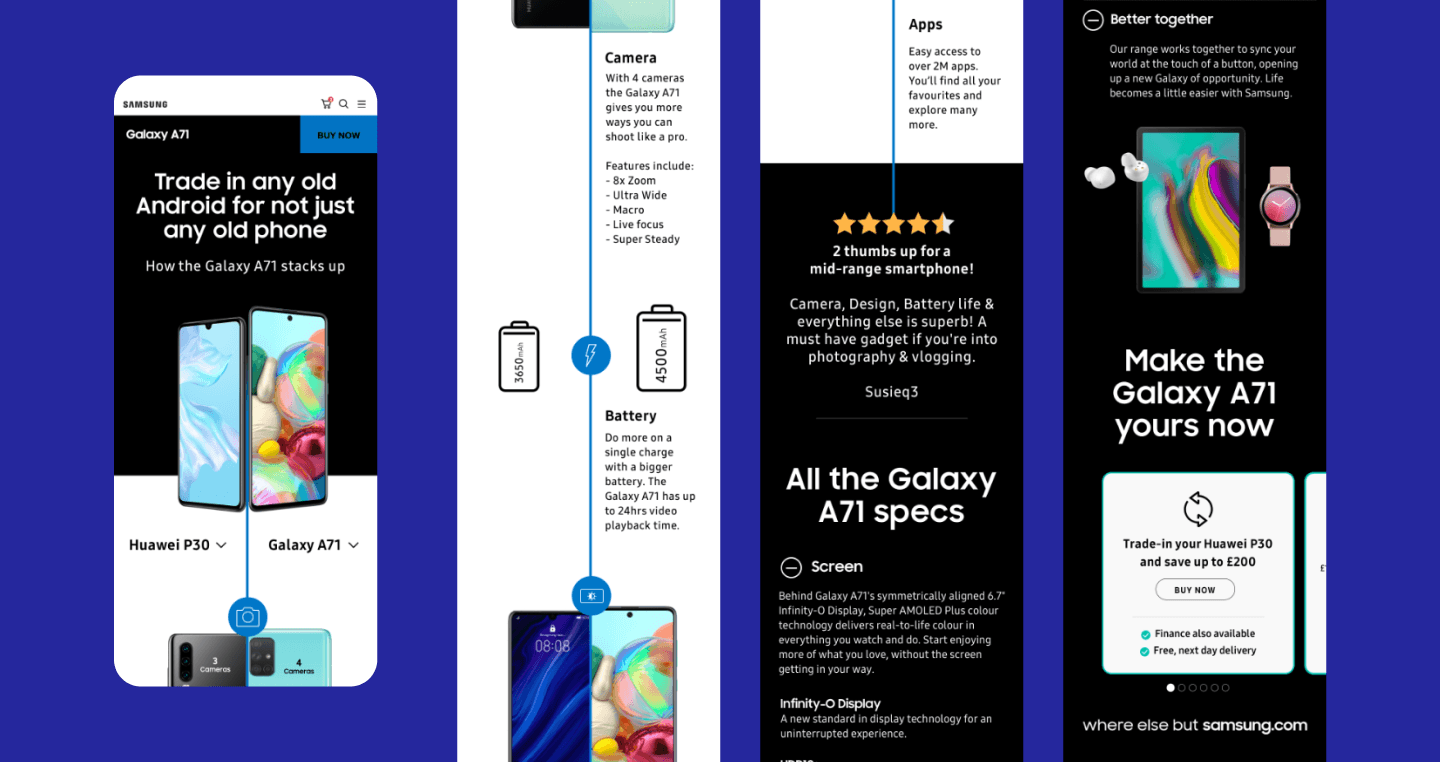
Design Phone Comparison
Opportunity; Comparison
When evaluating device comparisons, we’re in a uniquely strong position—we already know the device a user is browsing from.
This allows a strategic shift from generic comparisons to highly personalised experiences. By dynamically tailoring pages to their current device, we can highlight the most relevant upgrade benefits.
Improved User Experience
The result is a compelling, context-aware journey that feels highly relevant and makes the upgrade case hard to resist.
Pair this with strong social proof, key specifications, and clear purchase pathways—all structured within a strategic hierarchy.
This creates a high-performing experience that could be scaled across the most popular devices our users were browsing from.
Optimisation 2
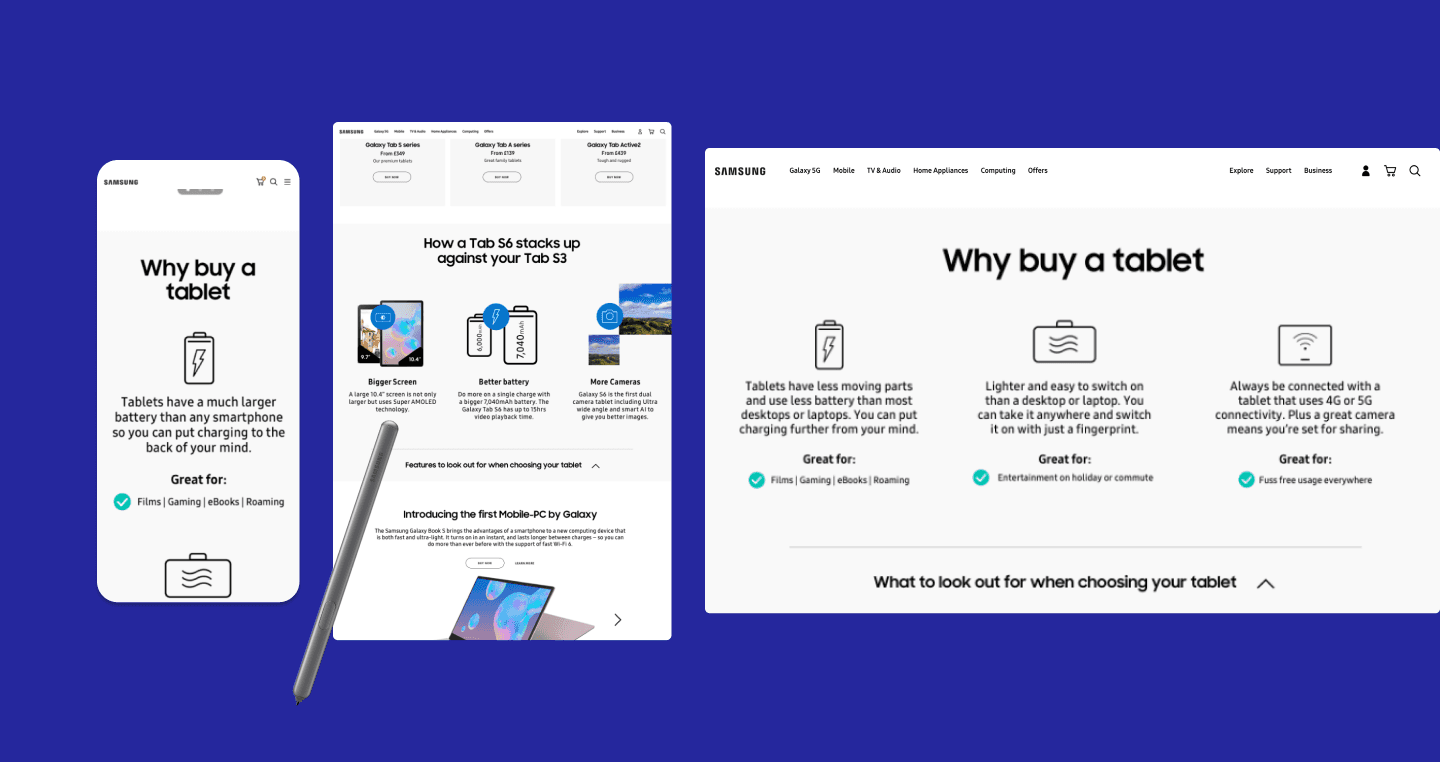
Design Tablet Personalisation
Opportunity; Personalisation
The tablet purchase journey was identified as a key opportunity on the Samsung.com site.
The category page, in particular, showed the greatest potential as this is where users were dropping off.
Research into the page highlighted that they were not effectively educating users on the different tablet models or supporting confident progression down the funnel.
Improved User Experience
Alongside a data-informed refresh of the page, I introduced a personalised “Why buy a tablet” module powered by device detection at the browser level.
The experience dynamically adapted content based on the user’s current device. For mobile and desktop users, the messaging emphasised the advantages of a tablet over their existing device. For users already on a tablet, the module shifted to a direct, model-level comparison.
Optimisation 3
Design Reasons to believe
Opportunity
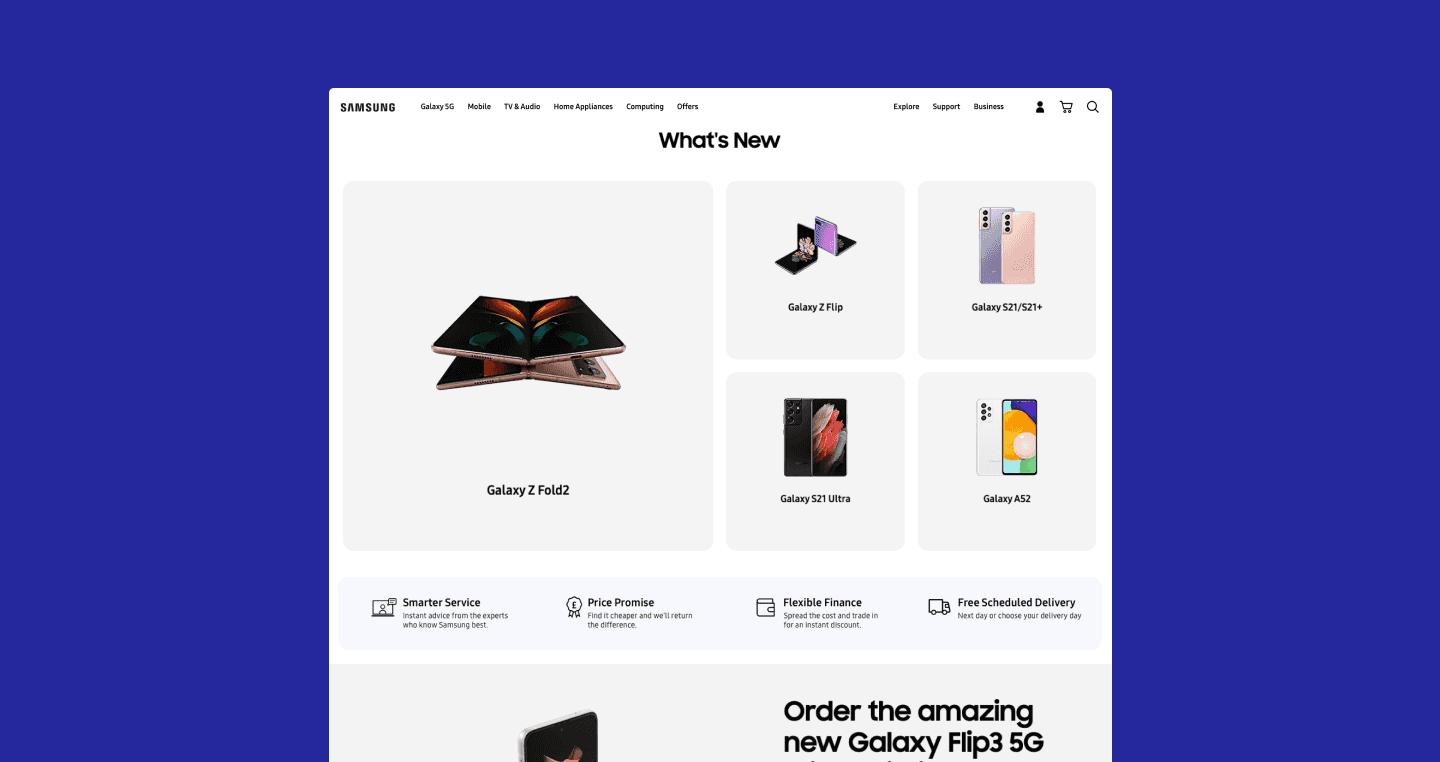
This optimisation was to refine the messaging and positioning of Samsung’s reasons to believe (CVPs/USPs) to better support conversion throughout the user journey.
Sometimes the most effective experiments are the simplest!
Improved User Experience
Building on the existing inclusion of RTBs, we analysed then tested which messages performed best at each stage of the funnel and across different product categories. Resulting in an array of different RTB banners across the site.
This created a more strategic, context-driven approach—moving away from a one-size-fits-all global model to tailored messaging that aligned with user intent.
16%
Total sales increase on Samsung.co.uk
+53%
Conversion Rate
+2.3M
EU Beat to Target
This was delivered by a highly effective, cross-functional team operating with a tight sprint cadence—shipping experiments and generating validated results each cycle, ready for monthly client reviews. We consistently outperformed targets, with successful optimisations adopted by Samsung HQ and rolled into global flagship launches.
Once the UK program ended, we scaled across seven European Samsung.com markets, where we revalidated high-performing optimisations in new contexts. This required adapting to market-specific behaviours, varying business requirements, and the complexity of localising designs across seven languages.
Throughout the project, I enjoyed operating beyond a traditional UX scope—contributing at pace across strategy, experimentation, and delivery to meet the demands of a high-velocity optimisation programme.